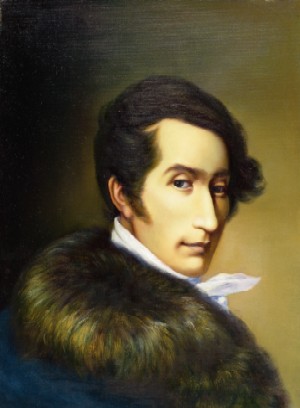
Carl Maria von Weber.
https://en.wikipedia.org/wiki/Carl_Maria_von_Weber
1. Bienvenidos, yo soy Terry Ewell. Éste es el video sobre el Andante del Andante y Rondo Húngaro de Weber.
2. I mentioned in the prior video some of the Hungarian rhythmic aspects of the Rondo. The Hungarian aspects expressed in the Andante are quite different. The Lombard rhythm, short-long, starts the melody in measure two and is repeated many times. Portions of this movement refer to the Siciliana, which is a 6/8 dance with the dotted eighth, sixteenth, and eighth note rhythm.
2. Mencioné en el video anterior algunos de los aspectos rítmicos del Rondó. Los aspectos húngaros expresados en el Andante son bastante diferentes. El ritmo Lombard, corto-largo, empieza la melodía en el compás dos y se repite muchas veces. Algunas porciones de este movimiento hacen referencia a la Siciliana, que es una danza en 6/8 con un ritmo de una corchea con puntillo, una semicorchea y una corchea.
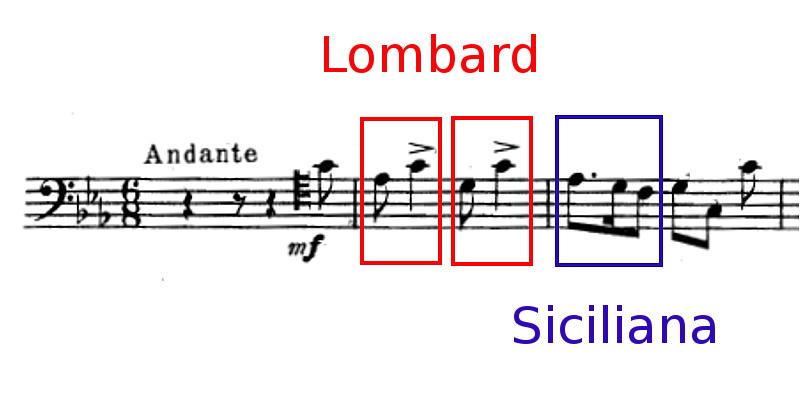
3. You can see that rhythm in measures three and five. Now, neither of these rhythmic devices are associated solely with the Hungarian or Gypsy idioms, however, they set the mood that this is a composition that departs from the typical Common Practice composition. The exoticism or “otherness” of the Andante is most persuasively conveyed by its insistence on rhythmic and dissonant stresses off the beat. Notice in the opening that Weber provides accents on the “off beats” of the Lombard rhythms. These rhythms are found in measures two and four and later in the composition. Furthermore the placement of dissonance often avoids strong metrical positions.
Let’s examine this more closely by studying the analysis by Dr. Melissa Kritzer on page 76 of her dissertation.
3. Pueden ver ese ritmo en los compases tres y cinco. Ahora, ninguno de estos patrones rítmicos están asociados solamente con giros gitanos o húngaros, sin embargo, establecen el hecho de que esta es composición se aleja de la típica práctica compositiva habitual. El exotismo del Andante es transmitido más persuasivamente por su insistencia en acentos rítmicos y disonantes sobre tiempos débiles. Nótese en el comienzo que Weber provee acentos en los tiempos débiles del ritmo Lombard. Estos ritmos se encuentran en los compases dos y cuatro y más adelante en la composición. Además, la ubicación de la disonancia a menudo evita posicionamientos métricos fuertes.
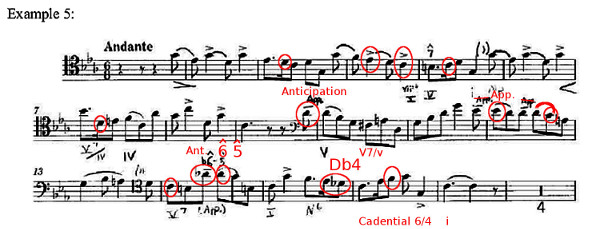
4. My markings are in red in Example 5.
4. Mis marcas están en rojo en el ejemplo 5. En algunos casos las disonancias en la melodía de Weber son parte de la práctica tradicional y en muchos otros son expresiones de exotismo: evocando el aspecto húngaro de la composición. He remarcado todas las notas disonantes, o sea las notas que no entran en la armonía del acompañamiento. En los compases 3, 5 y 7 las notas de paso del ritmo de Siciliana no son inusuales. El gran salto en el compás 7 es un cambio de octava. Do4, Re4, Mi4. Las características inusuales de esta melodía, sin embargo, comienzan en el compás 4. Weber no solo destaca con acentos las partes débiles de cada tiempo sino que además coloca disonancias sobre esas notas. Podemos encontrar más disonancias sobre tiempos débiles al final del compás 9 y en el medio del compás 14.
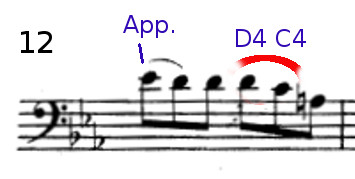
5. Measure 12 provides a temporary reprieve and I give stresses on the beat here. There is a real appoggiatura on the downbeat and then I play the next beat with the same stresses and slurred articulation. Aside from the traditional use of dissonance in the Siciana rhythm and measure 12, it is important to convey the usual placements of these dissonances to the listener.
5. El compás 12 ofrece un alivio temporal y se acentúa el tiempo fuerte. Hay una appoggiatura sobre el tiempo fuerte y toco el siguiente tiempo con los mismos acentos y articulación ligada.
A parte del uso tradicional de la disonancia en el ritmo de Siciliana y el compás 12, es importante transmitir al oyente estas disonancias en su ubicación habitual.
6. The Db4 in measure 15 (Example 5) is given over the chord of a Neapolitan Sixth. Technically this Db is a consonance with the Neapolitan Sixth. However, the note is so unusual and striking at that point in harmony that I have circled note again showing its emphasis on the offbeat. Although my analysis differs from Dr. Kritzer’s this in no way diminishes the fine research she has done. I concur with her observations that many of the dissonances are strategically placed off the beat in this theme to enhance the exotic and unexpected nature of this melody.
6. El re b 4 en el compás 15 (ejemplo 5) está sobre un acorde de sexta napolitano. Técnicamente este re b está en consonancia con el acorde. Sin embargo, la nota es tan inesperada en ese punto de la armonía que la resalté otra vez para mostrar su énfasis en el tiempo débil. Aunque mi análisis es diferente del de la Dra. Kritzer, esto de ninguna manera opaca la exhaustiva investigación que ella llevó a cabo. Estoy de acuerdo con sus observaciones en que muchas de las disonancias están estratégicamente colocadas en tiempos débiles en este tema, para enaltecer la naturaleza exótica e inesperada de esta melodía.
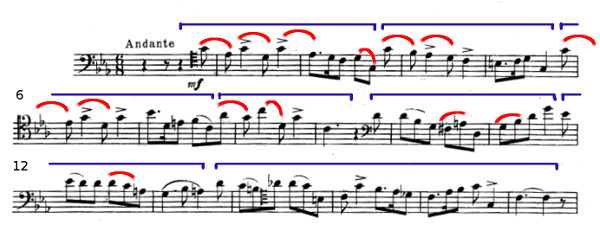
7. Weber presents hypermeter in this melody. Hypermeter is a combination of measures into a larger unit. The blue brackets indicate that two 6/8 measures are combined; the first measure with the Lombard and the second with Siciliana rhythms. Performing the melody (measures 1-13) with 12/8 measures instead of two 6/8 measures will enhance the expression. Thus, each two measures features a slight crescendo and decrescrendo with the climax occurring on the downbeat of the second measure.
7. Weber presenta en su melodía el “híper-metro”. El híper-metro es la combinación de varios compases en una unidad mayor. Los corchetes azules indican que dos compases de 6/8 están combinados; el primer compás con el ritmo Lombard y el segundo con el de Siciliana. Interpretar la melodía (compases 1-13) con compases de 12/8 en lugar de compases de 6/8 va a favorecer la expresividad. Por lo tanto, cada dos compases se da un ligero crescendo y decrescendo, y el clímax ocurre en el primer tiempo del segundo compás.
8. The pickup to measure 14 breaks with the previous pattern and is presented as a four measure phrase. I add the slurs in the figure to enhance the expression of the melody and also to provide more emphasis to the accents. Tonguing, rather than slurring into the accent, gives the note more emphasis. I tongue the downbeats in measures 7 and 9 to increase my accuracy on those notes. In measure 12 I slur from the appoggiatura downbeat and repeat the same gesture in the next beat from D4 to C4.
8. La anacrusa del compás 14 rompe con el patrón previo y se presenta como una frase de cuatro compases. Yo agrego las ligaduras en la figura para favorecer la expresividad en la melodía y también para dar más énfasis a los acentos. Separar, en lugar de ligar hacia el acento agrega énfasis a la nota. Yo separo los tiempos fuertes en los compases 7 y 9 para favorecer la exactitud de estas notas. En el compás 12 ligo desde el tiempo fuerte de la appoggiatura y repito el mismo gesto en el tiempo siguiente desde el re4 al do4.
9. El movimiento Andante tiene forma de variaciones, con cuatro presentaciones del tema. En la presentación 2 y 4, comenzando en los compases 22 y 60, el fagot hace un acompañamiento y tiene que insertar sus notas rápidas dentro de la melodía que está en las cuerdas. Recuerde seguir el fraseo híper métrico de la melodía que describí previamente.
10. The low register articulation can be tricky in this movement.
10. La articulación en el registro grave puede ser un desafío en este movimiento.
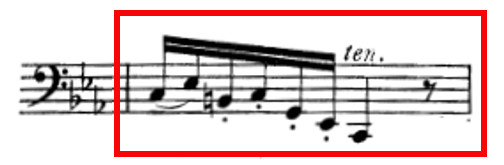
11. It is even more of a problem in the Weber concerto.
11. Este problema surge aún más en el concierto de Weber.
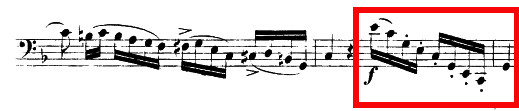
12. The key to both is to use
the same air stream and embouchure for the articulated notes as one would use
for slurring the same notes. For example, in measure 28 let’s first practice
this section slurred.
12. La clave en ambos casos es usar la misma columna de aire y embocadura para las notas articuladas de la misma forma que se haría para tocar las mismas notas si estuvieran ligadas. Por ejemplo, en el compás 28 practiquemos primero esta sección legato. Prestemos mucha atención a la embocadura y a la columna de aire.
13. Don’t bounce the embouchure around, rather keep it
stable as if you were slurring. For instance, for the low C pretend that you are
playing low A. This will keep the pitch down and also help you with your air
stream. Now just lightly brush the tongue on the reed add light tonguing in
order to articulate this.
13. No mueva la embocadura, sino manténgala estable como si estuviera ligando. Por ejemplo, para el Do grave, imagine que está tocando un La grave. Esto va a mantener la afinación baja y también le ayudará con el flujo de aire. Ahora, ligeramente deslice la lengua sobre la caña y agregue una ligera articulación. Sonará lo suficientemente corto con la articulación ligera sobre la caña, y apuntar a esas notas graves ayudará a que no se suba la afinación.
14. I provide musical contrast in measures 39-55 much
as I did in the pickup in measure 9 continuing on to measure 13. Longer and more
lyrical notes are called for here. Notice that Weber did not include as many
accents, and in measure 50 the accents are more like expressive appoggiaturas
rather than unexpected exotic notes. Here is a portion of that passage.
14. Yo aporto contraste musical en los compases 39-55 tanto como lo hice en la anacrusa al compás 9 continuando hasta el compás 13. Aquí vienen bien las notas más largas y líricas. Nótese que Weber no incluyó tantos acentos, y en el compás 50 los acentos son más como appoggiaturas expresivas que notas exóticas inesperadas. Ésta es una porción de ese pasaje. El tercer video examinará las características del Rondó. Este movimiento provee un cierre energético a la composición. Gracias.
Copyright (c) 2016 by Terry B. Ewell. All rights reserved.
Copyright © 2016 por Terry B. Ewell. Todos los derechos reservados.